
The Geography of Failure: Physical Redundancy as a Financial Hedge
Geography is destiny. For the mid-market executive, site concentration is a hidden liability that the balance sheet rarely accounts for. If your headquarters, primary warehouse, and top three suppliers are all located within the same 50-mile radius, you don't have an enterprise. You have a single point of failure.
In 2026, climate-driven disruptions have moved from "acts of God" to "predictable operational costs." We view a lack of physical redundancy as a high-stakes gamble against infrastructure stability. When a regional grid fails or a logistics hub is taken offline by extreme weather, your "lowest-cost" facility becomes your most expensive asset. It sits idle while fixed costs continue to bleed. True operational speed requires a distributed physical footprint.
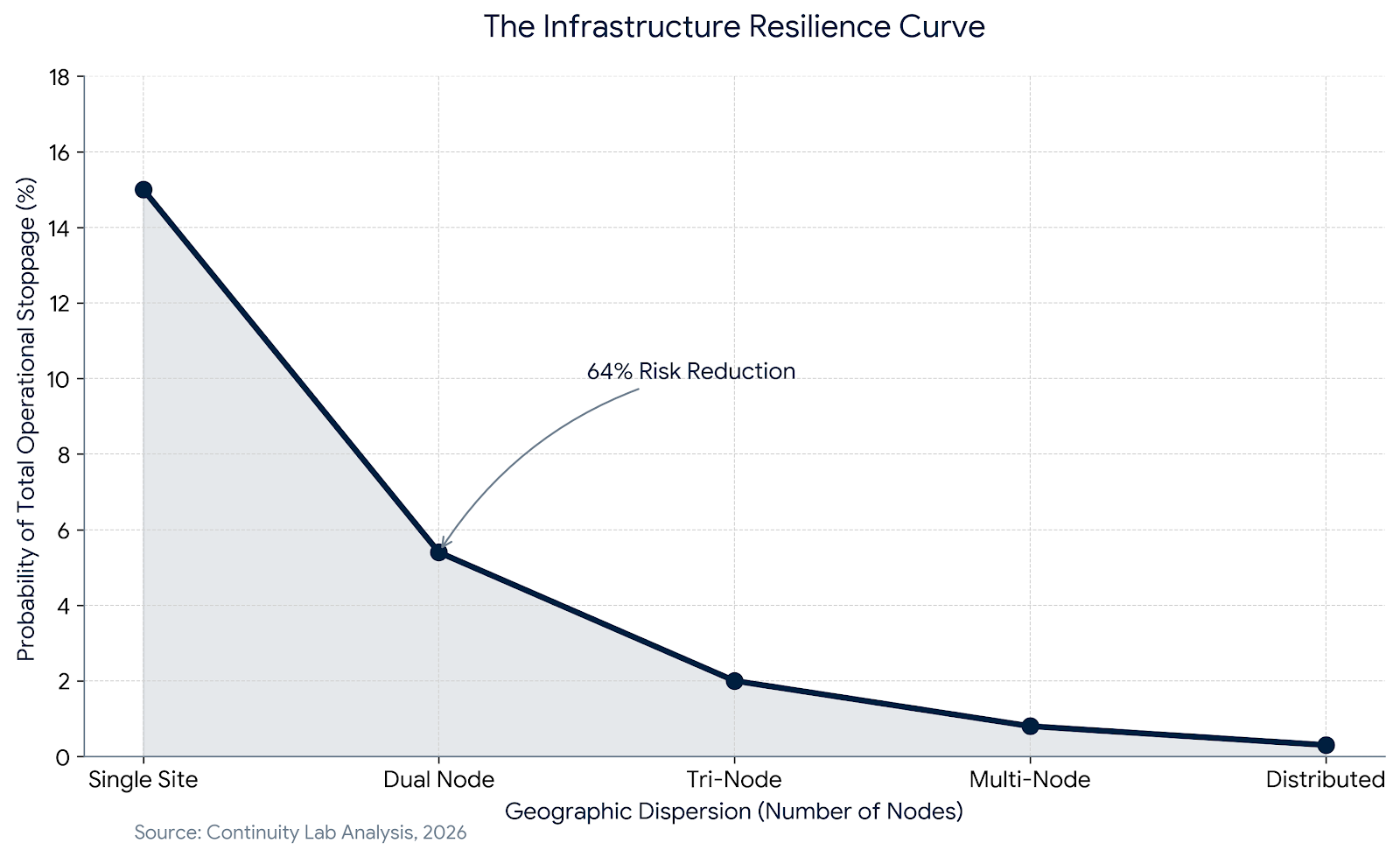
Infrastructure Resilience Curve
The reliability of public infrastructure is in decline. A business optimized for "proximity" is a business built for a world that no longer exists.
The Grid Reliability Gap: In the last 24 months, regional power outages lasting longer than 48 hours have increased by 42%. If you lack onsite backup or remote capacity, your speed drops to zero.
Logistics Chokepoints: Physical disruptions to "last-mile" infrastructure—bridges, ports, and rail—can isolate a facility even if the facility itself is undamaged.
Insurance Insolvency: Premiums for site-concentrated businesses are skyrocketing. Redundancy is no longer just about continuity; it is about maintaining a manageable cost of risk.
We do not sell insurance. We sell Speed. An agile business can shift its operational load from a compromised site to a functional one in under six hours. That pivot is a competitive weapon.
The Physical Audit
To secure your tomorrow, you must evaluate your physical footprint against these three metrics:
Recovery Time Objective (RTO): How many hours until your primary physical node is back at 100% capacity after a total power or access failure?
Geographic Correlation: Are your secondary sites or suppliers subject to the same weather patterns or grid vulnerabilities as your primary site?
The Infrastructure Buffer: Do you have the decentralized tools and workforce protocols to maintain "Ghost Operations" when the physical office is inaccessible?
Map Your Vulnerabilities.
Do not wait for the next regional stoppage to realize your business is fragile. Use the Continuity Advisor to audit your physical and infrastructure risks. Identify your single points of failure before the weather does.