
The Concentration Penalty (Why Your Lowest Unit Cost Is Your Biggest Risk)
Most SME executives manage their supply chains for a world that no longer exists. They consolidate volume with a single vendor to capture a 5% margin improvement. They celebrate the "efficiency" of a lean, just-in-time model.
This is a tactical error.
By optimizing for unit cost alone, you are effectively shorting global stability. You are borrowing against your future operational continuity to fund today’s margins. We view vendor concentration as a form of high-interest debt. When the primary supplier fails (due to a port strike, a cyber attack, or a regional conflict) the debt comes due immediately.
In the mid-market ($20M to $50M ARR), a total supply chain stoppage does not just dip your P&L. It erases it. Data from the 2026 Annual Supply Chain Risk Report indicates that significant disruptions now carry a 27% annual probability for businesses in this tier. The average cost of these incidents has reached $1.5 million per day for manufacturing and high-tech sectors.
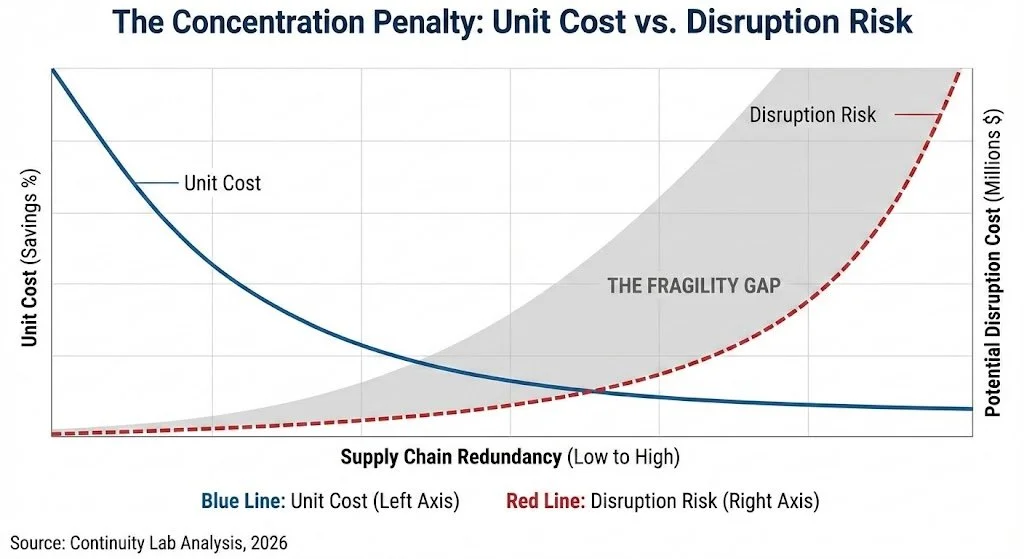
Concentration Penalty: Unit Cost vs. Disruption Risk Graph
The 2026 Landscape
The global logistics environment is structurally volatile. We have moved past "black swan" events into a state of permanent friction.
Geopolitical Fragmentation: Trade wars and sudden tariff shifts can change landed costs by 20% overnight.
Infrastructure Decay: Logistics networks are aging. A three-week delay at a primary port can trigger a liquidity crisis for a $20M business.
The Cyber Surge: Targeted attacks on 3PLs and carriers rose 64% last year. If your data or your goods are locked, your speed drops to zero.
Business owners who hold strategic redundancy are not "wasting" capital. They are purchasing the ability to play offense. When a regional crisis hits a specific geography, a decentralized supply chain allows you to pivot while competitors are issuing apologies. You win market share by being the only one capable of shipping. Speed is your most valuable product.
Actionable Metrics
True operational speed requires data (not intuition). Every executive must know these three numbers:
Time to Survive (TTS): How many days can your cash flow sustain a total stoppage from your primary supplier?
Value at Risk (VaR): What is the total dollar amount of revenue tied to your top three vendors?
Supplier Concentration Index: The percentage of your total spend concentrated in a single geographic region or political trade bloc.
If you cannot name these figures, you are not managing a supply chain. You are managing a hope-based system.
Quantify Your Risk Before the Market Does
The transition from a fragile to an agile business starts with a diagnostic. Do not wait for a port closure to find your single points of failure. Use the Continuity Advisor tool to generate a risk-adjusted view of your operations.